

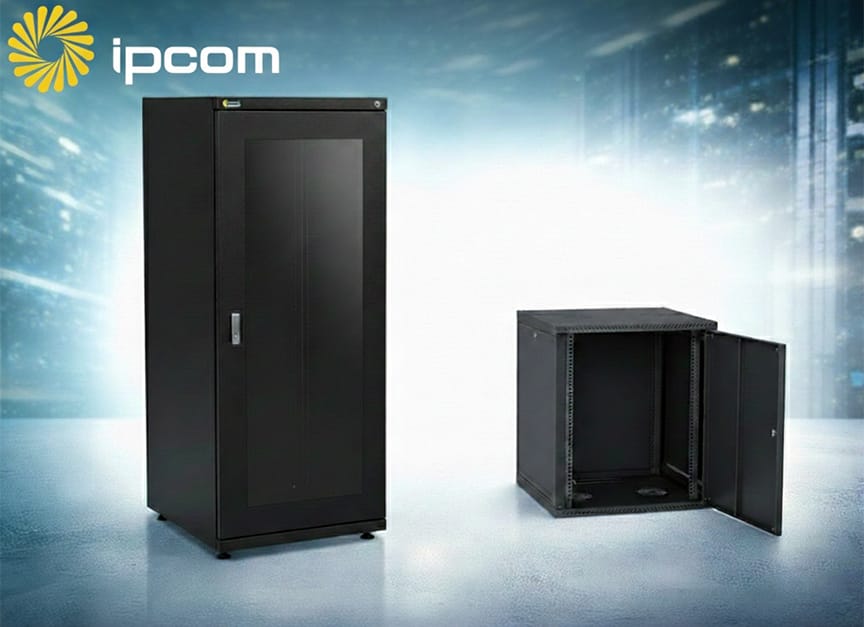
The difference between a network rack and a server rack is crucial in practice. As a manufacturer of 19-inch cabinets, we clearly distinguish between a network cabinet for structured cabling and active network equipment, and a server cabinet for high-weight, heat-intensive IT systems. The differences primarily concern load capacity, installation depth, airflow, cooling concepts, and mechanical stability design.
Basic Application of 19-Inch Rack Cabinets
- Server racks are designed for computing-intensive applications and secure data storage.
- Network cabinets are designed for structured signal and data distribution within the IT infrastructure.
Comparison of Technical Design
Although both network cabinets and server cabinets are designed as 19-inch systems, they differ significantly in construction, load capacity, and cooling concept.
Installation Depth and Dimensions
- Network cabinets are generally more compact and often have an installation depth of 600 to 800 mm.
- Server cabinets, on the other hand, have larger installation depths of 800 to 1200 mm or more to accommodate full server hardware and structured cable management.
Load Capacity
- Network cabinets are usually designed for a static load capacity of about 300 to 800 kg, as mainly lightweight components such as switches, patch panels, or routers are installed.
- Server cabinets, in contrast, reach load capacities of 1,000 to 1,800 kg, as they must safely support heavy servers, storage systems, and UPS units on a permanent basis.
Ventilation and Cooling Concept
- In a cabinet for network technology, heat generation is usually moderate, so passive ventilation or simple fan units are often sufficient.
- A server rack, however, requires more powerful cooling concepts due to the high heat load, such as perforated doors, optimized airflow, or integration of active cooling systems.
Mounting Type
- Cabinets for network components can be installed either wall-mounted or freestanding due to their lower weight.
- Server cabinets, on the other hand, are typically designed as floor-standing models.
Difference Between Network Rack and Server Rack in Application
- A cabinet for network technology is typically used in office buildings, branches, smaller technical rooms, or decentralized IT areas.
- A server rack, in contrast, is mainly used in data centers, central server rooms, or complex IT environments with high performance density.
Which IT Cabinet Is Suitable for Your Requirements?
The right IT cabinet for your needs depends on the type of equipment and its operating conditions. If you want to house network devices and the structural load is low, a network cabinet is the optimal solution. It is more compact, lighter, and can be wall-mounted or installed as a freestanding unit.
If you want to install servers, storage systems, UPS units, and other heavy equipment with high heat generation, you need a server cabinet. These cabinets are designed for greater depth, higher load capacity, and efficient ventilation. When selecting, the spatial conditions, heat dissipation, and possible future infrastructure expansions should also be considered.
Please let us know which devices and capacities are planned. We will provide professional advice and support you in selecting the right solution. As a manufacturer of 19-inch rack cabinets for indoor and outdoor use, we develop robust solutions for various IT requirements. We are happy to support you in choosing the right system for your infrastructure.
 info@ipcom-group.pl
 +48-57-35-69-079